
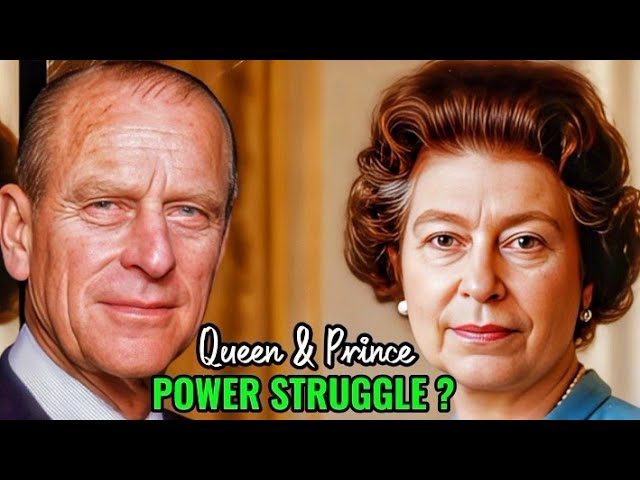
The Hidden Power Struggle Inside Queen Elizabeth II and Prince Philip’s Royal Marriage That Changed the British Monarchy Forever
For nearly seven decades, the reign of Queen Elizabeth II stood as one of the most stable symbols of constitutional power in modern history. Calm, controlled, and unwavering in public, she embodied the image of continuity in a rapidly changing world.
But behind the polished surfaces of royal duty and ceremonial tradition lay a far more complex emotional and institutional reality—one shaped by power, identity, and silent tension inside her marriage to Prince Philip.
This was not simply a royal love story. It was a clash between tradition and transformation, between inherited authority and constrained individuality. And at the center of it all was a monarchy that never truly shared power—even within marriage.
A Marriage Built Between Two Worlds
When Elizabeth married Philip in 1947, the world saw a confident naval officer joining the royal family. But behind the scenes, Philip was stepping into an institution that would quietly reshape his identity.
Before marriage, Philip was not a ceremonial figure. He was an active officer in the British Navy, accustomed to independence, structure, and personal authority. But the moment he entered the royal system, everything shifted.
The monarchy did not bend to accommodate him. Instead, it absorbed him.
What followed was not a partnership of equals in the traditional sense—but a carefully balanced hierarchy disguised as unity.
The Malta Years: The Closest Thing to a Normal Life
Royal historians and observers often point to the Malta period as the most emotionally balanced chapter in their marriage.
While stationed in Malta during Philip’s naval service, the couple experienced something rare: relative privacy, shared independence, and distance from palace control. Elizabeth was still a princess, not yet queen. Philip still had a career, a uniform, and a clear sense of identity.
In Malta, their relationship felt almost ordinary. They lived in modest accommodation, entertained friends freely, and shared responsibilities without the suffocating weight of monarchy.
But that chapter was brief.
Everything changed in 1952.
The Moment Everything Changed: King George VI’s Death
The death of King George VI in 1952 was not just a family tragedy—it was a constitutional rupture.
Elizabeth was in Kenya when she received the devastating news. In that moment, she was no longer a princess on a tour. She became Queen of the United Kingdom instantly, without preparation, without transition, and without delay.
From that moment forward, her life ceased to be personal. It became institutional.
Philip’s life changed just as dramatically—but in the opposite direction. He lost not only his naval career but also his clear sense of purpose. Overnight, he was no longer an active officer. He became a consort—an undefined role within a system that had no clear place for him.
The imbalance had begun.
A Name, an Identity, and a Silent Conflict
One of the most quietly controversial tensions inside the royal household revolved around names and legacy.
Philip, born into the House of Schleswig-Holstein-Sonderburg-Glücksburg and later adopting the name Mountbatten through his maternal lineage, faced a symbolic restriction that would follow him throughout his life: he was not allowed to pass his name to his children in the way he expected.
Instead, the royal family adopted the name Windsor, a politically engineered identity created during World War I to distance the monarchy from German associations.
The compromise of “Mountbatten-Windsor,” established in 1960, was seen as a symbolic acknowledgment of Philip’s frustration—but it did not change the deeper structural reality.
The monarchy does not share authority. Even within family identity.
The Courtiers Behind the Crown
While the public saw Elizabeth as the face of authority, insiders understood something more complex: the monarchy is shaped by layers of institutional control.
Senior courtiers—unelected, invisible, and highly influential—acted as gatekeepers of access, information, and decision-making. Even the Queen operated within a framework that filtered her environment.
Some historians suggest that Philip often clashed not directly with Elizabeth, but with this hidden administrative structure. His desire to modernize royal operations frequently ran into resistance from a system built on precedent rather than innovation.
In this sense, Philip was not just a husband adapting to royal life. He was a reformer confronting an institution designed to resist change.
The Coronation That Changed Everything
In 1953, the televised coronation of Elizabeth became one of the most significant turning points in royal history.
For the first time, millions of ordinary citizens were allowed visual access to a sacred ceremony that had previously been reserved for elite observation. The monarchy shifted from mystique-based authority to visibility-based legitimacy.
This decision was not without controversy. Some courtiers and traditionalists feared it would diminish the monarchy’s aura of sacred distance. Others, reportedly including Philip, saw it as a necessary evolution.
Even Winston Churchill played a quiet but influential role in shaping the monarchy’s direction during this period, reinforcing continuity while allowing controlled modernization.
The broadcast was a success—but it also marked a permanent shift: the monarchy would now exist under public gaze at all times.
Philip: The Modernizer Behind the Curtain?
Over time, a different narrative began to emerge among royal observers and historians. While Elizabeth embodied restraint and institutional continuity, Philip was increasingly seen as the force pushing for modernization.
He encouraged efficiency reforms within the royal household, advocated for updated communication systems, and pushed for a more relatable monarchy.
But not all of his ideas were welcomed.
Inside the palace, modernization was often viewed not as progress—but as disruption.
Philip’s personality—direct, expressive, and sometimes impatient with protocol—stood in contrast to Elizabeth’s controlled emotional style. Where she embodied silence and stability, he embodied change and challenge.
This contrast created an invisible tension that shaped the monarchy’s internal rhythm for decades.
The Emotional Divide: Duty vs Identity
One of the most striking dynamics in their marriage was the emotional contrast between them.
Elizabeth’s role demanded emotional neutrality. She was not expected to express personal frustration or vulnerability in public. Her authority depended on restraint.
Philip, by contrast, came from a military background where expression, opinion, and leadership were direct and immediate. His identity had once been defined by action.
The transition into royal life required him to suppress much of that identity.
Over time, this created what many observers interpret as a silent emotional imbalance: one partner shaped by institutional stillness, the other by restricted expression.
The Education of a Future King
Another subtle but significant area of influence was their approach to parenting, particularly in shaping King Charles III.
Philip’s philosophy, influenced heavily by his own education at Gordonstoun, emphasized resilience, discipline, and emotional toughness. This approach directly shaped the early education of Charles, particularly his time at Gordonstoun School.
However, this parenting style became a subject of ongoing debate within the royal household, reflecting deeper differences in how Elizabeth and Philip viewed emotional development and royal preparation.
A Marriage Defined by Structure, Not Equality
Looking back, many royal analysts argue that the Elizabeth-Philip marriage reflects something larger than personal dynamics—it reflects the architecture of monarchy itself.
The institution does not operate on shared authority. It operates on hierarchy, precedent, and controlled adaptation.
Philip was never an equal co-ruler. He was a consort within a system that defined his boundaries from the moment he entered it.
Yet within those constraints, he found influence—sometimes visible, often invisible, but always limited by structure.
Public Fascination and Ongoing Debate
Today, public interest in their relationship continues to grow, especially through documentaries and royal commentary. Fans and historians continue to debate key questions:
Was Philip truly the monarchy’s hidden modernizer?
Did courtiers hold more power than the public ever realized?
Was the coronation broadcast the moment the monarchy lost its mystery—and gained survival?
And perhaps most intriguingly: was their marriage a partnership of love, duty, or institutional necessity?
The answers remain layered and unresolved.
Conclusion: The Monarchy That Changed Without Breaking
The story of Elizabeth and Philip is not simply a royal biography—it is a study in controlled transformation.
The British monarchy did not collapse under modern pressure. Instead, it absorbed change slowly, carefully, and often reluctantly.
Through televised coronations, naming disputes, generational education, and quiet institutional battles, the monarchy evolved without ever fully relinquishing its core structure.
In the end, the marriage between Queen Elizabeth II and Prince Philip reflects a deeper truth about power itself:
Sometimes, the most important struggles are not the ones the world sees—but the ones that happen silently, inside systems built to endure everything except change.




Leave a Reply