
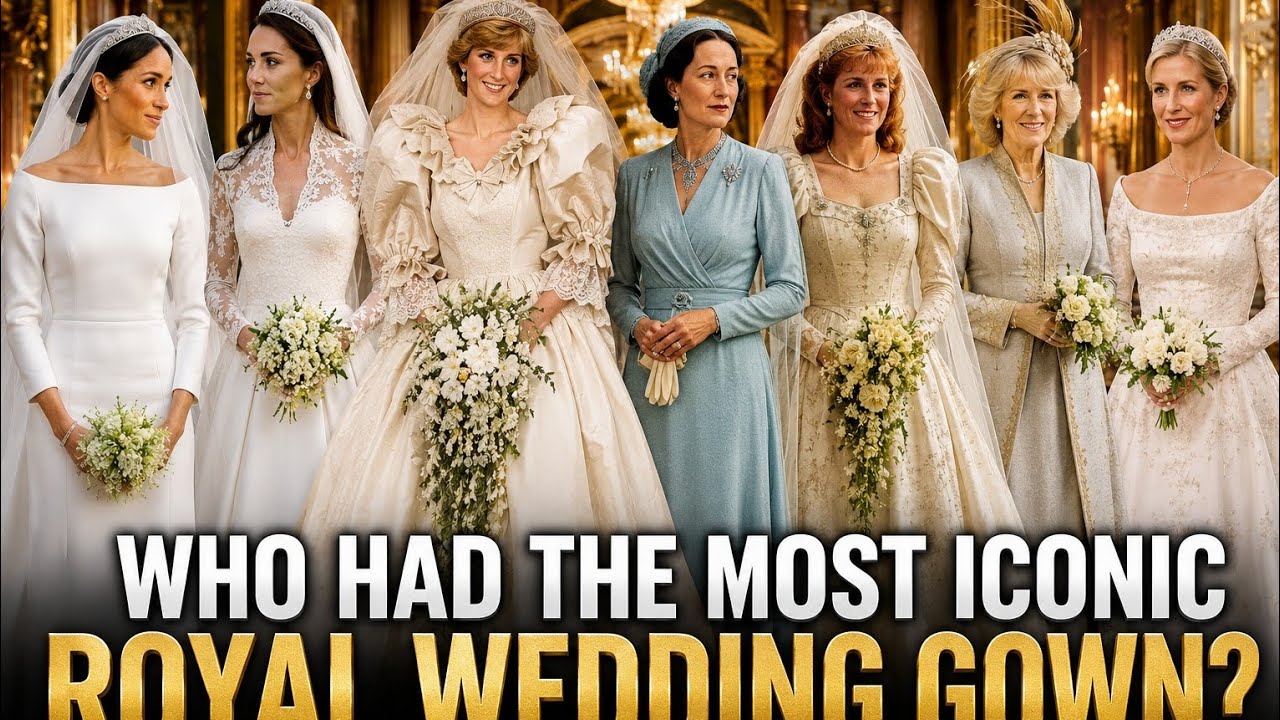
Royal wedding dresses are supposed to tell a story — not just about fashion, not just about tradition, but about the women who wore them, the eras they represented, and the futures they were about to step into. Some became symbols of fairy tale romance. Others became unforgettable for entirely different reasons. And a few remained so iconic that decades later, people still talk about them as if the weddings happened yesterday. But here is the fascinating part: not every royal bride got it right.
Some dresses aged beautifully. Others became victims of changing fashion trends. And a few left royal watchers wondering what on earth their designers were thinking. Today, we are ranking some of the most famous royal wedding dresses in modern history — from the most questionable choices to the gowns that truly stood the test of time. And by the time we reach number one, you may be surprised by which royal bride ultimately takes the crown.
Princess Diana: The Most Famous Royal Wedding Dress in History — and the Most Controversial
Let us begin with perhaps the most famous wedding dress in royal history — and also one of the most controversial. When Lady Diana Spencer stepped out of that carriage in July 1981, the entire world seemed to stop. Millions watched. Millions more would later see photographs splashed across newspapers and magazines around the globe.
This wasn’t simply a wedding. It was a global event, and Diana’s dress reflected that reality. Designed by David and Elizabeth Emanuel, the gown was intended to create a moment that people would never forget — and in that respect, it succeeded spectacularly. The ivory silk taffeta dress featured enormous puff sleeves, intricate embroidery, thousands of sequins, pearls, lace details, and perhaps most famously of all, a train that stretched an astonishing 25 feet. At the time, it was breathtaking. It was dramatic.
It was larger than life — exactly what people expected from a future Princess of Wales. Yet fashion can be cruel. What appears magical in one decade can seem excessive in another. Looking back today, many observers see Diana’s dress as a perfect symbol of the 1980s: grand, extravagant, and unapologetically oversized. Some love it, some don’t. But nobody can deny its place in history. Even now, decades later, museum exhibitions featuring the gown continue drawing enormous crowds. That is the power of Princess Diana. She didn’t just wear clothes — she created moments.
Wallis Simpson: The Intentionally Understated Dress That Changed Royal History
Next comes one of the most unusual royal wedding dresses ever worn — not because it was extravagant, but because it was intentionally understated. Long before Diana, before Catherine, and before Meghan, Wallis Simpson changed royal history forever. Her love story with King Edward VIII remains one of the most dramatic chapters in royal history.
Edward gave up the throne, walked away from the crown, and abandoned a future as king — all for the woman he loved. Their wedding in 1937 was unlike any royal wedding before or since. No grand cathedral, no cheering crowds, no royal spectacle — just a private ceremony in France, and Wallis dressed accordingly. Rather than choosing an elaborate royal gown, she wore a simple silk dress designed by Mainbocher.
Its most remarkable feature was its color. Although many photographs make it appear white, the dress was actually a custom shade of blue so distinctive that it eventually became known as Wallis blue. It was elegant, refined, and completely different from what people expected a royal bride to wear. Perhaps that was fitting. After all, there was nothing ordinary about Wallis Simpson’s story.
Sarah Ferguson: A Dress Packed With Symbolism — and Controversy
Then we come to Sarah Ferguson. When she married Prince Andrew in 1986, excitement surrounded the wedding from every direction. The young couple appeared deeply in love, crowds filled the streets, and expectations were enormous. Fergie’s gown certainly did not disappoint when it came to making an impression. Designed by Linda Cierach, the ivory satin dress was packed with symbolism. Almost every inch of fabric seemed to tell part of the couple’s story.
There were hearts representing their romance, anchors celebrating Andrew’s naval career, waves, bees, thistles, family crests, personal references, and a 17-foot train carrying their intertwined initials. The craftsmanship was extraordinary. The details were endless. Yet many modern observers feel the design may have tried to do too much at once. The shoulder pads alone firmly placed the gown in the 1980s. Still, as a snapshot of royal fashion history, it remains unforgettable. And perhaps that is exactly what a royal wedding dress should be.
Princess Anne: Two Weddings, Two Completely Different Approaches
Princess Anne’s first wedding gown is another fascinating example of fashion reflecting its era. When Anne married Captain Mark Phillips in 1973, styles were changing rapidly — and unfortunately, not all changes age gracefully. Her Tudor-inspired gown featured a very high neckline, a structured bodice, and dramatic sleeves that gave it an almost medieval appearance.
Some royal fashion historians admire its uniqueness. Others compare it to an oversized turtleneck. Either way, it remains one of the most distinctive royal bridal looks ever seen. What makes the dress so interesting is that despite its unusual design, Princess Anne carried it with complete confidence — and confidence often matters more than fashion itself.
Years later, when Anne remarried Commander Timothy Lawrence, she chose something dramatically different. Gone was the fairy tale princess look. Gone was the enormous gown. Instead, she selected a simple white suit: practical, elegant, and refreshingly understated. While some critics joked that it resembled a flight attendant’s uniform, others praised Anne for ignoring trends and embracing a style that felt authentically her own. In many ways, it perfectly reflected her personality — no fuss, no drama, just practicality. A trait that has defined Princess Anne throughout her entire life.
Camilla Parker Bowles: Sophisticated, Mature, and Wisely Restrained
By the time Camilla married Prince Charles in 2005, circumstances were very different from most royal weddings. Both had lived long, complicated lives. Both had experienced public scrutiny. And both understood exactly what the moment represented. Camilla wisely avoided attempting to compete with traditional royal bridal expectations.
Instead, she wore a sophisticated cream gown beneath a pale blue and gold embroidered coat. The outfit struck a careful balance between elegance and maturity. Most observers agreed she looked beautiful, although there was one detail that divided opinion — the feathered headpiece. For some, it added flair. For others, it stole attention from the rest of the outfit. Still, considering the complexity of the occasion, Camilla managed to strike an impressive balance. And that is no easy achievement.
Sophie Rhys-Jones: The Gown That Achieved Timelessness
As we move closer to the top of the list, we arrive at Sophie Rhys-Jones. When she married Prince Edward in 1999, her gown delivered something many royal dresses struggle to achieve: timelessness. At first glance, the dress appears simple — but closer inspection reveals extraordinary craftsmanship. Hundreds of thousands of pearls, crystal beadwork, hand-dyed silk organza, and elegant tailoring. More than two decades later, the gown still feels remarkably modern — which is perhaps the greatest compliment any wedding dress can receive. Because true elegance never goes out of style.
Meghan Markle Versus Catherine: The Debate That Divides Royal Fans to This Day
And now we arrive at two of the most celebrated royal wedding gowns ever created — and the debate that continues to divide royal fans to this day. When Meghan Markle married Prince Harry in 2018, expectations were enormous. Would she choose glamour, drama, Hollywood sophistication? Instead, Meghan surprised everyone.
Her Givenchy gown embraced simplicity: clean lines, minimal decoration, elegant tailoring. The dress allowed the craftsmanship to speak for itself. Paired with her breathtaking veil featuring embroidered flowers representing Commonwealth nations, the result was undeniably striking. Some critics felt it lacked detail. Others considered it refreshingly modern.
Either way, Meghan succeeded in creating a look that instantly became part of royal history. But for many royal fashion enthusiasts, one bride still stands above all the rest. When Catherine stepped out at Westminster Abbey in 2011, it felt as though a modern fairy tale had come to life. Everything about the gown seemed perfectly balanced — the lace sleeves, the fitted bodice, the flowing skirt, the elegant train, designed by Sarah Burton for Alexander McQueen.
The dress combined centuries of royal tradition with modern sophistication. It felt regal without appearing stiff, luxurious without appearing excessive, and classic without feeling outdated. More than a decade later, fashion experts still reference Catherine’s gown as one of the greatest wedding dresses ever worn by a royal bride. And perhaps that is because it achieved something rare: it didn’t overshadow Catherine. It reflected her.
Conclusion: The Bride Wears the Dress — Not the Other Way Around
The very best royal wedding dresses don’t wear the bride. The bride wears them. And Catherine’s gown remains the perfect example of that principle. But the question remains open. Did Princess Diana’s legendary dress deserve a higher ranking? Was Meghan’s modern simplicity more impressive than Catherine’s classic elegance? Or is there another royal bride who deserves the top spot? When it comes to royal wedding fashion, the debate never truly ends — and that is precisely what makes these extraordinary gowns so endlessly captivating.

Leave a Reply